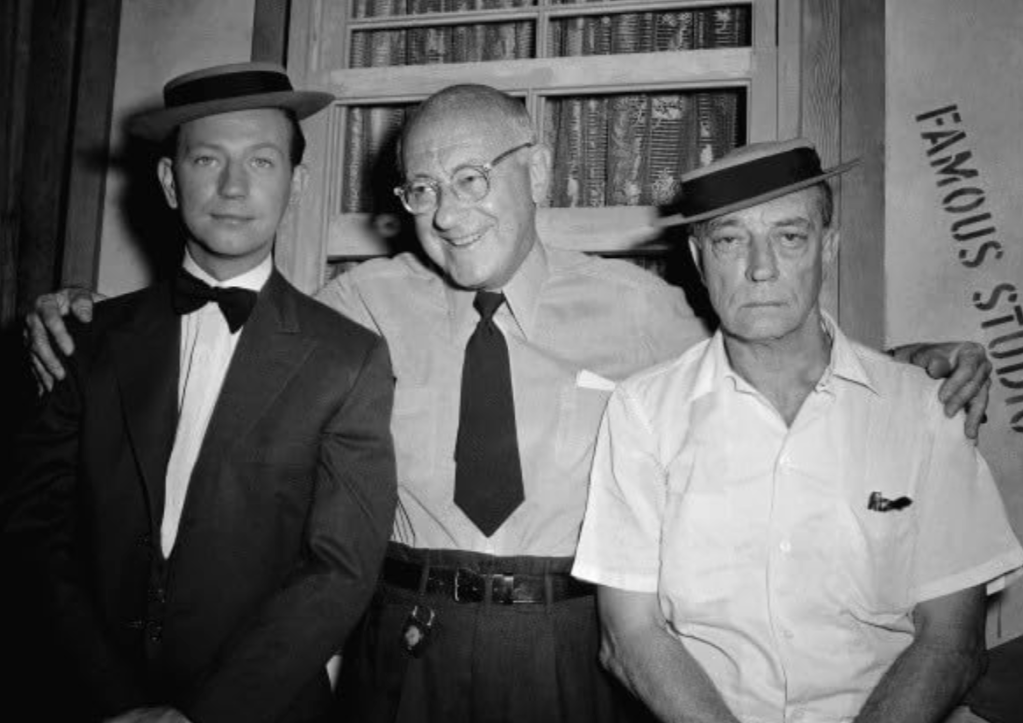

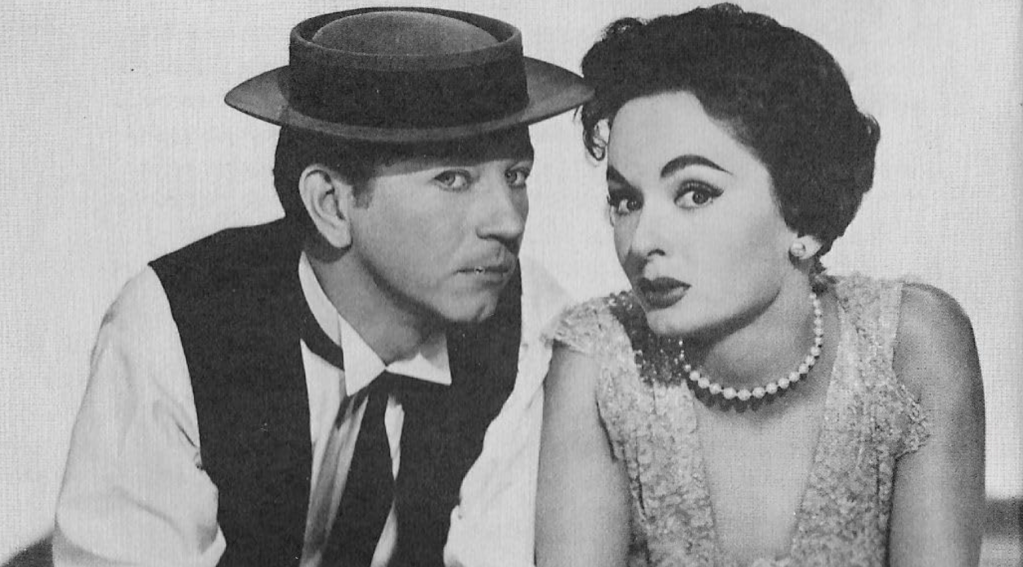
When I first heard about The Buster Keaton Story at length it was in Dana Stevens’ recent biography “Cameraman: Buster Keaton, the Dawn of Cinema, and the Invention of the Twentieth Century” released in 2022. While I highly recommend the book, a gripping account of Keaton’s full life and career, Stevens relayed a story I found upsetting. The author described the premier of the film, and how, not long into the screening, Buster himself and his wife Eleanor left under cover of the dim theatre lighting out of sheer embarrassment at the way he was being presented. Naturally, I had to know just how bad it was.
Before I provide some context about Keaton’s life for the sake of those unfamiliar, I would like to assert that nearly everything about this downright disrespectful film was utterly infuriating to me. I knew to expect something offensive enough to warrant the Keatons vacating the theatre, but it was so much worse than I expected. My jaw had dropped into my lap and I was having rageful heart palpitations after the first 12 minutes.
Keaton performed as a child in a vaudeville act with his parents, three shows a day beginning at age four. According to Rudi Blesh’s 1967 biography which drew from extensive interviews with Keaton himself shortly before his death, Myra, his mother, had begun bringing Buster to watch in the wings when he was two years old, deciding he was safer in eyeshot than with their landlady after a series of injuries and accidents that had happened when little Buster was in her care. Before his fourth birthday, he began testing his physical capabilities with dangerous stunts paired with deadpan reactions for comic effect. This was something he perfected and continued to do into his first film appearance with Roscoe Arbuckle in 1917 at age 22. Maybe you’ve seen the famous stunt from Steamboat Bill Jr., released in 1928, where the actual two ton face of a house falls nearly perfectly around Buster’s five foot five inch frame after grazing his right shoulder.
Keaton had had tremendous success with his independent work, 25 minute two reelers as well as full length films, but after he signed a contract in 1928 selling his soul to Metro-Goldwyn-Mayer, he completely lost the total creative control he was accustomed to. Steamboat Bill Jr, with the clip from earlier, was the last film he would make independent of MGM, and Buster knew full well what he would be giving up with this new studio deal. Maybe that’s why, knowing it would be his final project with his independent company, he chose to take on a stunt that was even more dangerous than usual.
Things went just as he probably anticipated. The studio didn’t take advantage of Keaton’s strengths as they made a transition into talking pictures. Instead of utilizing his keen comedy instincts, they attempted to pair him in a truly abysmal comedy team with the Borscht belt sensation Jimmy Durante, whose distinct style aggressively contrasted with Buster’s. After that, Keaton’s personal life and career entered a steep, painful, and public decline as he plummeted into crippling alcoholism.
After this decline, as a combined result of studio oppression and two failed marriages, MGM decided Buster was too much of a liability, and, determining he was not profitable, terminated his contract in 1933 leaving him poor and in disgrace. By 1957 when The Buster Keaton Story was produced he had returned to Hollywood behind the scenes as a gag writer for famous individuals and teams like the Marx Brothers. But he was still hurting for money. His first wife Natalie had taken him for all he had, his money, the Italian Villa that was built for her, and full custody of his two sons. By some grace, she did not request alimony payments, but Buster would still never recover from the financial as well as emotional costs of his first marriage. Needing the money, he sold the B movie masters at Universal the rights to his life story. And here we can begin to talk about where everything went wrong. Really wrong.
The conductor who drove this train entirely off the tracks was Sidney Sheldon. Sheldon came from a playwriting background, having created several so-so books of Broadway musicals. Sorry to the “Merry Widow” stans, I guess. He transitioned to writing screenplays in the forties. He was on the three-man writing team for Easter Parade, which would star Judy Garland and Fred Astaire with great success. He eventually won an Academy Award for his screenplay of “The Bachelor and the Bobby Soxer” in 1948 starring Cary Grant and a teenage Shirley Temple, who was by this point in her career trying her damnedest not to be seen as the Animal Crackers in My Soup girl. Movies, and later with the advent of television, TV shows, with saccharine, inauthentic writing spun like cotton candy were this man’s bread and butter. So why did he have the audacity to stray from his profitable formula of trope-filled fluff to attempt a dramatic look at a real life character? He, moreover, was given the task of directing his monstrocity, something he would only do twice in his whole career in cinema. And now we know why.
Sidney Sheldon’s personal perspective and experience in show business skue the entire movie, from its historically inaccurate start to its puzzlingly fictitious finish. One of the first problems I noticed in the writing was the depiction of the early days of Hollywood, in which the beginning of the story takes place. In what is theoretically the late 1910s, there is depicted a domination by executives from ambiguous fictional studios representative of the Big Five. In real life, the five most powerful studios of the Golden Age were Metro-Goldwyn-Mayer, Paramount, Warner Brothers, 20th Century Fox, and RKO Radio Pictures. But these ruling forces wouldn’t have fully developed into what film historians think of as the studio system, the infamous artistically oppressive money-making machine, until the late twenties and early thirties with the first mass distributed talking pictures. Sheldon didn’t have real life context on which to base his writing, as he wasn’t an active screenwriter until 1941, with an ephemeral B movie thriller called “South of Panama”. The scrappy early days of American filmmaking were full of innovative creators and artists like those who Buster met through comedian and filmmaker Roscoe Arbuckle.
Arguably one of the people most important to Buster’s entrance into filmmaking, Arbuckle was entirely neglected in the script. This could be because Arbuckle had been ousted from Hollywood after a very public scandal in 1921, accused of a crime he was ultimately acquitted of committing, but truly I think he was omitted for the movie not out of sensitivity, but of sheer laziness. But this new world of daring independent cinema was long dead by 1941 when Sheldon began writing for the screen and long since maggot chow by 1957 when Sheldon was writing this script.
It really shows that Sheldon had no perspective on the way filmmaking was prior to the studio system, and the lack of authenticity detracts from building the proper context for the story. I think the reason Sheldon was chosen to write the “biographical” movie was, as I said, Hollywood in 1957 was almost purely a capital venture. Fluff played well and Buster’s name was still a draw, so his real life story was scrapped in favor of something Universal was sure would get butts in seats. In many ways, Hollywood hasn’t changed in that regard. Relentless pandering for the purpose of reaping revenue over making art is not new, and unfortunately may never leave the film industry as we now know it.
From the anachronistic costuming to the perplexing sound design the whole thing is just a mess. But one of the biggest obstacles arises from the casting.
Some big wig at Universal, presumably having seen the Make ‘Em Laugh sequence in “Singin in the Rain” in 1952, decided Donald O’Connor, with his high energy and dancer’s agility would be able to comparably reproduce Buster’s high-risk stunts. O’Connor is nimble, no doubt, but even that isn’t enough to save him from the challenge of dramatic acting. Famously a comic with a background in musicals, he was wildly unsuited for a serious look at the darkest chapter of Keaton’s life. To his credit, there are fleeting moments where he tries to capture the singular cadence of Keaton’s gravely midwestern tone. He was the technical director of the film, on set frequently, and O’Connor clearly made a conscious effort to get to know the man he was portraying.
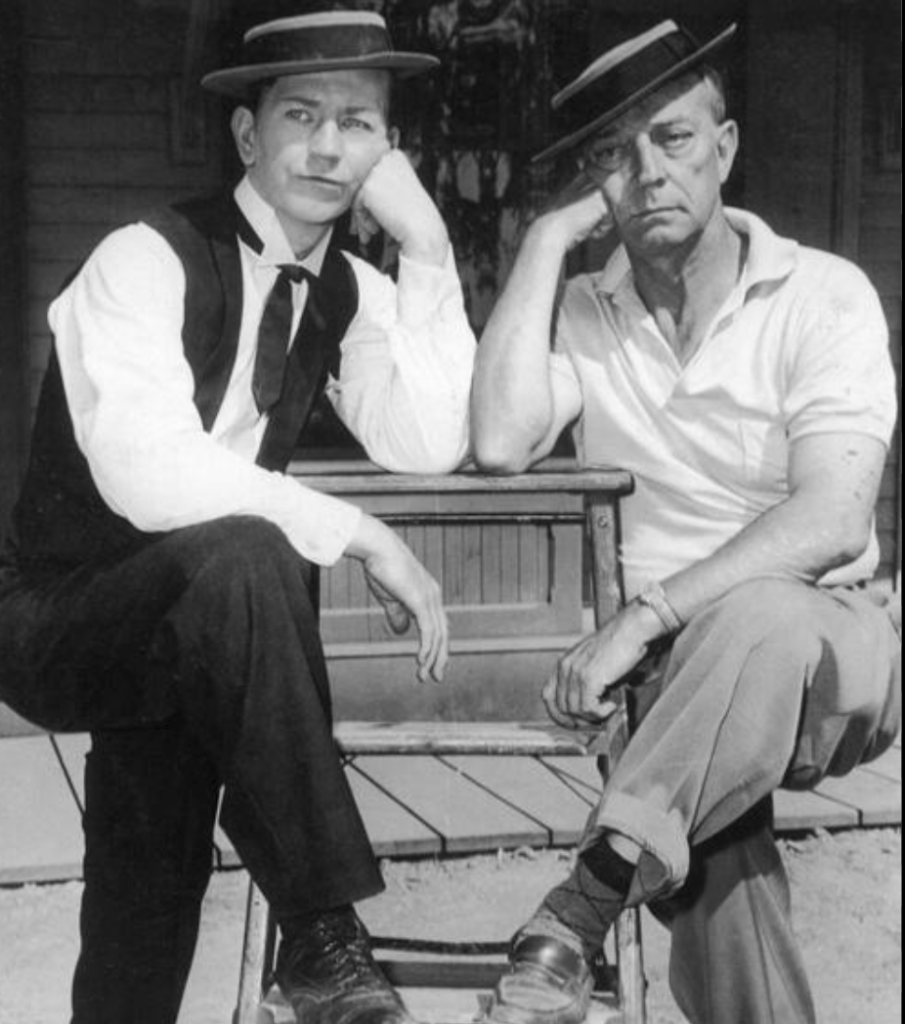
Though the recreations of the stunts are fairly well executed thanks to O’Connor’s physical skill and undoubtedly Buster’s direction, the way he chose to imitate Keaton’s comic acting in between stunts was puzzling. Buster Keaton is known as The Great Stone Face, from his trademark deadpan reactions and subtlety of expression. O’Connor chooses instead to gesticulate comically, entirely incongruous with Buster’s comic style. It’s more relative to what Oliver Hardy would have been showcasing with Stan Laurel around the same time. In a moment intended to mimic a scene from the 1921 short film “The Goat”, which they renamed “The Criminal” in this for some inexplicable reason, O’Connor’s Keaton smiles triumphantly after evading police capture and smugly enjoys a banana. The whole point of The Goat is actually that he does end up captured. The grim end card of the film is a headstone on which is ominously written The End, with Buster’s famous hat laid atop the gravestone. They included this end card in that “The Criminal” part of The Buster Keaton Story, which is an even stranger choice as it was a part of the real life short film “Cops,” not “The Goat.” Putting the comedy mistakes aside, another more dramatic scene in the film shows a tragic meltdown by Keaton, at his wit’s end during filming. Out of respect for O’Connor’s illustrious memory, I will avoid fully elaborating on his bold attempt at drama by saying… A for effort, Don.
Finally, arguably the most heinous series of errors that persist throughout the entire film are in the area of historical accuracy within the true story they claim to be telling. It makes me wonder if Sidney Sheldon ever actually spoke to Buster even once before writing the screenplay. As soon as the opening credits end, the script completely diverges from the reality of Keaton’s life. Buster’s parents, under whose shoddy real-life supervision he undertook dangerous feats on stage, were depicted in this movie as concerned about the effects of the stunts on their child’s physical condition, which, in the film, were being pushed on the little boy by heartless vaudeville producers.
In actuality, it was Buster’s own father Joe Keaton, who he was named for, who pushed for these stunts to continue, which frequently resulted in the injury of his toddler. Buster, aged four at the time, and his father had an act where they engaged in a series of roughhousing stunts, including one where Buster was lifted off his feet and thrown against the back wall of the stage set. Child abuse even being considered a crime was new at the time, but somehow Keaton’s parents were able to avoid any consquences for endangering the little boy for a very long time regardless. They lied that he was seven years old when asked, as that was the minimum age for child performers at that time, and they were able to skirt the rules by technicality, as their performance style was far from traditional. Most child performers were singing or dancing, and the law was written to reflect that. In an interview Buster explained, “The law didn’t say a word about taking me by the nape of the neck and throwing me through a piece of scenery.” I understand that a typical 1957 moviegoing audience might have found a more truthful prologue depicting child abuse to be troubling, but it makes sense that they lied about Buster’s childhood, given that the philosophy of the whole film seemed to be, “let’s give the people what they’ll want to come see”. Apparently Universal believed that audiences wanted to see a complete fabrication and a hurtful reimagining of a true story.
Another alteration I resent is the implication that Buster’s transition to MGM was a failure because of an inability to perform in the context of sound. Once again contrasting with the lived reality, the issue was not one of a lack of capability to adapt to the evolving parameters of the medium, but that he wasn’t granted control of his projects. Real-life Buster delivers comedy dialogue well in the MGM talkies, or as well as he can given the quality of the material. He had an acute sense of what plays well on screen, actually. Which is something many actors, who all came from theatre, weren’t able to adapt into.
When your face is on a thirty foot tall screen, facial expressions and gestures need to be presented differently than they would be for the consideration of audience members in the second balcony. In fact, one of the reasons Buster had so much success in silents was the subtle dexterity of his facial expression, and that subtlety which was essential to screen performance was something many actors in the early days of film lacked. Some never caught on to it, and their careers petered out as a result. That was not the case, as it is implied, for Buster Keaton. It petered out for entirely different reasons.
There is a scene in the film where O’Connor’s Keaton is exasperatedly criticized by his director, played for some mysterious reason by Peter Lorre, for neglecting to speak clearly into the microphone. Keaton was in actuality highly technically astute and extremely conscious of the demands of the technology and I dislike that they insinuated he was suddenly out of his depth with the introduction of sound. While that may have been the case for a large number of silent actors, it really didn’t prove to be a problem for Buster. In all my research and reading I have never once encountered any anecdotal evidence of technical ineptitude with Keaton. When O’Connor’s Buster feebly suggests he incorporate a stunt into the scene, Lorre’s director coldly responds, “Pantomime is dead, Mr. Keaton. Pictures now talk.”
Additionally, the inclusion of two invented love interests who never existed is only further insult. The love triangle with actress Peggy Courtney and Hollywood secretary Gloria Brent is the product of Sidney Sheldon’s dull, formulaic imagination. The women depicted in the movie are completely fictional.
Why not incorporate the drama of Buster’s life with first wife Natalie Talmadge and her pair of emasculating sisters, and what about Keaton’s rollercoaster of a hasty second marriage to Mae Scriven, his nurse while he was in rehab?
When the true story is so much more interesting, it seems absurd to entirely scrap it in favor of this mediocre tropey nonsense. The opening title card of The Buster Keaton Story reads, “this is the sad, happy, loving story of one of the immortals of the silent screen.” Sad, happy, and loving, perhaps, but it is not his story.
Truly, Buster’s actual story is far more riveting than what Sheldon concocted, and it seems like a disappointing missed opportunity. Buster Keaton was present for the birth of American cinema, a major architect behind and in front of the camera shaping what the medium would become. Why not tell that story?
Aside from all of the missteps I have mentioned, I think perhaps the most horrifying error of all was that Buster Keaton himself was alive and forced to witness the butchering of his personal story. As technical director there were days he was on set, almost certainly there to witness the blatant falsifying of facts and characters from his own life. Did he have to watch silently from behind the camera as Donald O’Connor stumbled in exaggerated drunkenness and fell onto a conveniently located couch to be held by a tearful woman who never really existed?
It’s also possible Buster didn’t know exactly how distressingly egregious and insulting the film would be until it was actually screened. Apparently, Buster and his wife Eleanor escaped the premiere of the movie in utter embarrassment, under cover of the low lighting in the theatre. I think it must have comforted him to know that the movie was not successful enough to experience a wide viewing audience, and now, the depiction we see perpetrated in “The Buster Keaton Story” is not how he is currently remembered. Keaton himself once said with earnest humility, when rightly accused of being a genius, “no man can be a genius in slapshoes and a flat hat.” I think many people today would disagree.
Someone please give us a real, honest to God biographical film account of Buster Keaton’s life. Something fittingly dramatic and respectful and truthful. Think what they did for Charlie Chaplin in 1992, which featured faithful representations of real people. Robert Downey Jr. gives incredible life to and breathes humanity into egotistical child-chaser Chuck Chaplin in a remarkably executed BAFTA-winning and Oscar nominated performance. Kevin Kline gives a very human portrayal of silent action hero Douglas Fairbanks and Dan Ackroyd is the significant but now rarely remembered silent director Mack Sennett. Every named character in the film is based on a real person, down to Marrisa Tomei’s single scene performance as oft-forgotten silent actress Mabel Normand and that attention to detail is so admirable. The depiction of Chaplin’s time at Sennett Studios, particularly the scene in the cutting room, are very true in their representation of early film technology and editing. Even the costumes are impeccable, whereas in The Buster Keaton Story, the fashion isn’t reflective of the period in which it takes place, but more true instead to the fashion of 1957 when the film was produced. And when the style of the 20s was so distinctive, why?
Truly, I’m not asking for every detail of Buster’s story to be told like what was done with Chaplin, but something akin to a grain of truth would be wonderful. I think we owe it to Keaton to memorialize him in a more accurate and flattering light than in the abominable account Buster himself was forced to bear witness to, which completely erased his accomplishments in favor of presenting his failures. Additionally, perhaps in the future it would behoove Hollywood to wait until someone has died to make a biopic about them. We didn’t have the end of Buster’s story yet.
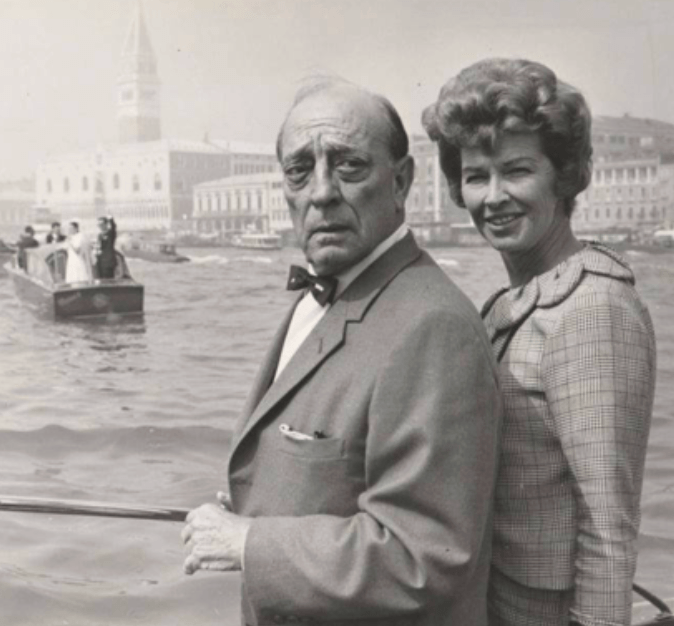
After 1957, Keaton experienced something of a revival as there was a well-deserved rediscovery of his films and an effort by historians to collect and restore them. So many films of the silent era were carelessly misplaced or destroyed and it’s really kind of a miracle that all of his work survived. In the 1960s, there was a resurgence of recognition for Keaton and his tremendous work in progressing the medium of film. In France and other parts of Europe, film festivals dedicated to him were held and he got picked up for more projects, frequently featuring nods and tributes to his trademark style. In his last film appearance in “A Funny Thing Happened on the Way to the Forum” released posthumously in 1966, his hat costume piece and incorporation of stunts during the chase scene were a direct send up of what he produced in the 1920s.
Someone right the wrongs of our forefathers at Universal and remake “The Buster Keaton Story”. I think the man deserves it.
If you are already a fan of Buster Keaton, please do not watch this so-called “biopic”. Go rewatch some of the two reelers or the full length projects. If you don’t know his work, my top two reeler pick is One Week, about a pair of newlyweds trying to construct their mail order home. It’s a bit of a dig at the houses that could be purchased from the Sears catalog at the time. And it features Sibyl Seeley, my personal favorite of Buster’s leading ladies. And this may be a controversial take, but if you have to find one full length to start with, I would start slow with a nice soft choice like Sherlock Jr. Then move on to more ambitious projects like Steamboat Bill or The General. And you can watch any of them on youtube for free. We love public domain content.
Signing off,
René Spell
 silents, golden age, and beyond
Leave a comment